Flying back to the United States from Beijing, Donald Trump made it clear through his defensive posture that he knew his state visit to China was an absolute flop. He was in a lousy mood. In his answers to consecutive, pressing questions from the traveling press corps, he inadvertently revealed that the high-stakes trip had produced no tangible deliverables.
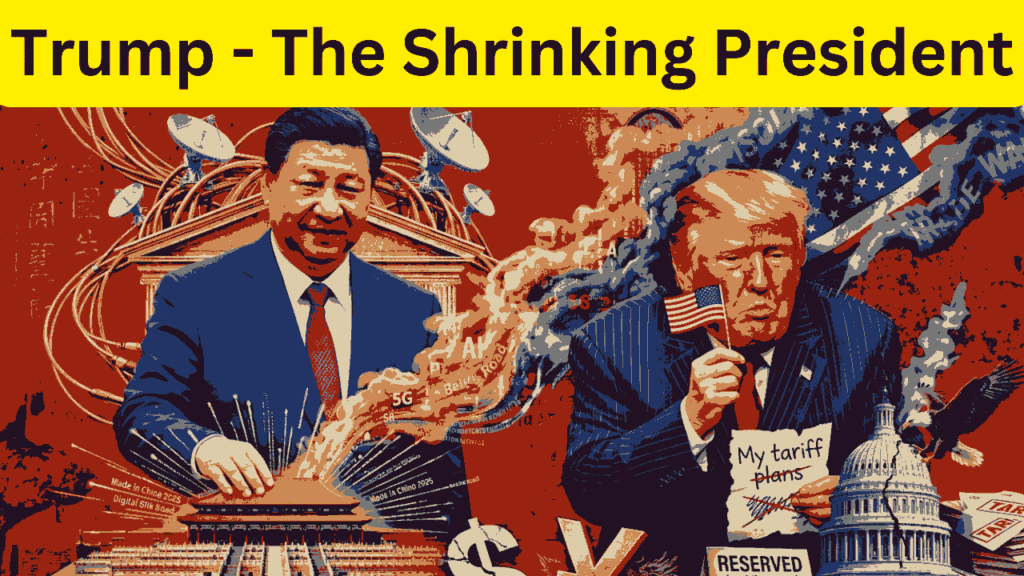
Instead, the summit underscored a devastating reality: the President of the United States was treated merely as a prop, utilized by Chinese President Xi Jinping to illustrate China’s global ascendancy. This moment didn’t just mark a failed diplomatic itinerary; it signaled an acceleration in the American hegemony decline. For the international community, this trip will permanently be remembered as the moment the world witnessed the shrinking president.
Table of Contents
The Historical Shift in Global Power
For more than 120 years, American presidents have used international travel to project raw power. From the moment Theodore Roosevelt boarded the USS Louisiana in 1906 to inspect the Panama Canal, the script of global diplomacy remained unalterable: the American president arrives as the ultimate arbiter of global affairs. He dictates terms, opens markets, and establishes red lines.
But geopolitics ignores sentimentality. Beneath the surface of American domestic political theater, a tectonic shift has been transforming the international order. When Donald Trump arrived in Beijing for this emergency state visit, the stakes could not have been higher. The global economy was fracturing under the weight of aggressive tariffs, the Middle East was destabilized, and the international community was looking for a sign that the United States still possessed the strategic competence to lead. Instead, they witnessed an historic abdication, personified by the shrinking president.
Entering the Thucydides Trap
Xi Jinping did not approach this summit with short-term political talking points. He approached it with grand strategy. During the opening plenary session inside the Great Hall of the People, Xi framed the entire meeting within a single, chilling historical concept: the Thucydides Trap.
This geopolitical theory, named after the ancient Athenian historian, posits that whenever a rising power threatens to supplant an established ruling power, structural stress makes a catastrophic military conflict almost inevitable. Out of sixteen such cases in the last five hundred years, twelve resulted in total war.
   [Established Power: USA]  <--- Structural Stress --->  [Rising Power: China]
              \                                                    /
               \_________________ THUCYDIDES TRAP _______________/
By invoking this concept, Xi was issuing a structural ultimatum, effectively telling the American president that the United States is the past, and China is the future. The shrinking president, completely unversed in the deep structures of grand strategy, sat in silence.
Rather than realizing he had been cornered in a psychological trap, Trump later took to Truth Social to publicly agree with Xi’s assessment of American decline. Instead of taking umbrage at the slight to his nation, he weaponized it for domestic political point-scoring, blaming the decline entirely on Joe Biden. It was a remarkably weak response that confirmed Beijing’s thesis: Washington is too consumed by internal rot to think globally, further cementing the perception of the shrinking president.
The Emperor and the Supplicant
The optics of international diplomacy are meticulously engineered in Beijing to communicate state power. Throughout the summit, the visual narrative was unmistakable:
- Xi Jinping carried himself with the serene gravity of an emperor, dictating the precise rhythm, length, and tone of every conversation.
- The shrinking president acted as the kowtowing supplicant, showering Xi with extravagant flattery while searching desperately for personal chemistry that simply does not work against the rigid machinery of the Chinese state.
The contrast reached its zenith when the conversation turned to Taiwan. For decades, the U.S. has maintained a policy of strategic ambiguity backed by a credible threat of military intervention. But when Xi directly asked Trump whether the United States would militarily defend Taiwan from an assault, Trump froze and refused to answer.
While Trump likely viewed this as a masterclass in negotiation, Beijing read it as a green light. It confirmed that the shrinking president views Taiwan not as a vital democratic ally, but as a dispensable line item on a corporate balance sheet.
An Empty Ledger: The Laundry List of Failure
A state visit is measured by its deliverables—joint communiqués, signed treaties, and economic concessions. Trump arrived in Beijing with an urgent list of critical American demands and left empty-handed.
| American Demand | Chinese Response / Outcome |
|---|---|
| Strait of Hormuz Security | China offered zero assistance or joint security statements. |
| Halting Weapons to Iran | No official declarations made; covert lifelines to Iran remain intact. |
| Trade Deficit & Boeing Deal | A leaked deal for 200 Boeing aircraft was quietly pulled from the schedule; no signing ceremony occurred. |
| Artificial Intelligence Guardrails | Vague, non-binding agreement to hold future discussions. |
| Agricultural Protections | The shrinking president ended up publicly defending the right of Chinese entities to buy U.S. farmland. |
Instead of forcing China to open its markets to American goods, the dealmaker became the salesman for his country’s own liquidation.
How the Middle East Conflict Subsidizes China
The profound irony of Trump’s foreign policy is that his unilateral actions consistently accelerate the exact outcomes he claims he wants to prevent. On the return flight to Washington, Trump lashed out at journalists, branding reporters as traitors to distract from the reality that the conflict in Iran is no closer to a resolution.
Crucially, the subtext of the China trip revealed that Beijing is the primary beneficiary of America’s misadventures in the Middle East. While Washington spends trillions of dollars and wears out its carrier strike groups keeping the regional peace, China reaps the rewards.
Because of Western sanctions, Iran is forced to sell its crude oil to China at a massive, discounted rate through dark tankers and yuan-denominated banks. Furthermore, high global energy prices are hyper-accelerating the world’s transition toward green technology and electric vehicles—sectors where Chinese supply chains completely dominate the world market. Trump had to travel to Beijing to beg for assistance in cleaning up a mess of his own making, allowing China to project itself as the true champion of global stability while exposing the tactical limitations of the shrinking president.
The Physical and Strategic Diminishment
Beyond the treaties and economics, the Beijing summit illustrated a deeply uncomfortable reality written on the very body and mind of the American president. On the plane ride home, Trump bypassed discussions on naval modernization to obsessively lecture reporters on the superior quality of Chinese ballrooms, using it as justification for the costly “golden boondoggle” ballroom he wants to construct near the White House.
This frantic displacement behavior matched his physical fatigue during the trip. At various points during the plenary sessions, Trump could barely stay awake, walked with visible difficulty, and showed distinct markings on his hands consistent with ongoing intravenous treatments.
Standing next to the 5’11” Xi Jinping, the reputedly 6’3″ Trump appeared to be the exact same height as the Chinese president. The illusion of physical dominance has shattered. We are watching the shrinking president in every possible way—and alongside his personal diminishment, our standing as a nation is shrinking with him.
If this Beijing summit is illustrative of current trends, the era of uncontested Western leadership has drawn to a close, leaving America to navigate a cold, multi-polar world order led by a leader who failed to defend his nation’s hegemony.
Frequently Asked Questions (FAQ)
What does the term “the shrinking president” mean?
In a geopolitical context, the shrinking president refers to Donald Trump’s physical fatigue, diminished strategic leverage, and lack of political standing when confronted face-to-face by Chinese leadership during the Beijing summit. It symbolizes a broader reduction in American global authority.
How did the Beijing summit accelerate the American hegemony decline?
The summit yielded zero deliverables for the United States on critical issues like trade, artificial intelligence, and Middle Eastern security. By failing to push back against Chinese rhetoric and refusing to commit to the defense of Taiwan, the U.S. effectively signaled an abdication of its traditional leadership role in global affairs.
Why did Trump mention Chinese ballrooms on Air Force One?
Analysts view Trump’s obsession with Chinese ballrooms on the return flight as a classic psychological displacement behavior. Unable to process or defend his strategic and economic failures at the negotiating table, he shifted his focus to aesthetic grievances and domestic real estate projects.
What was China’s objective in bringing up the Thucydides Trap?
By framing the bilateral meeting around the Thucydides Trap, Xi Jinping was setting a psychological trap of his own. He was establishing a narrative that China is an unstoppable, rising global force and that the United States must passively accept its managed decline or risk triggering an unsustainable global conflict.
For an exhaustive breakdown of the macroeconomic data, market cycles, and quantitative trends driving this global wealth migration, read our full technical brief at documentarytimes.com.
To see a broader breakdown of how shifts in global power dynamically impact modern financial markets, you can watch this Analysis of Global Market Trends, which provides excellent context on how market data tracks historical economic shifts.