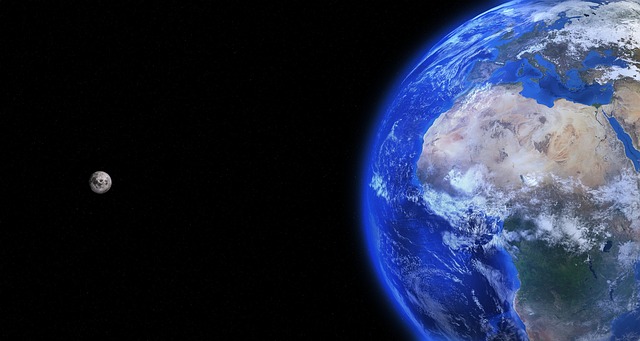
The moon leaving earth is not a science fiction scenario. It is not a distant possibility. It is happening right now, silently, predictably, at a rate of exactly 3.8 centimetres per year.
That number — roughly the width of a walnut — sounds trivial. It is anything but.
The same measurement, extended forward across geological time, eliminates one of the most spectacular phenomena in the natural world: the total solar eclipse. No future civilization will ever witness what humans alive today take for granted. The corona, the diamond ring, the stars appearing at noon — all of it is temporary. And the clock is already ticking.
This article explores the moon leaving earth in full depth: how we know it is happening, why it happens, what it means for the future of total solar eclipses, and why you are alive at exactly the right moment in Earth’s history to witness something no future human will ever see.
Table of Contents
The Cosmic Coincidence That Makes Eclipses Possible
Before understanding why the moon leaving earth matters, we must first understand why total solar eclipses exist at all.
A total solar eclipse is not a miracle. It is a coincidence — and a temporary one at that.
The Sun is roughly 400 times wider than the Moon. It also happens to sit, on average, roughly 400 times farther from Earth. Those two ratios cancel each other perfectly. From the ground, the lunar disc and the solar disc subtend almost exactly the same angle in the sky: about half a degree.
That is why the Moon can, at specific points in its slightly elliptical orbit, cover the Sun’s photosphere completely while leaving the corona exposed.
No other planet in the solar system has this geometry.
Mars has two moons, both too small and too close to produce anything resembling totality. Jupiter’s largest moons are wildly oversized relative to the Sun as seen from Jovian orbit. The Earth–Moon system is the only place where the ratio holds — and it holds only for a window of cosmic time that human civilization is currently inside.
The moon leaving earth is slowly, inexorably, closing that window.
How Scientists Discovered the Moon leaving earth
The discovery that the moon leaving earth is not a theory — it is a measurement. And it is one of the most precise measurements in all of science.
The value of 3.8 centimetres per year comes from the Lunar Laser Ranging Experiment, a program that has been running continuously for more than fifty years.
Here is how it works:
Observatories on Earth fire powerful lasers at small, suitcase-sized mirrors left on the lunar surface. The laser photons travel to the Moon, bounce off the mirrors, and return to Earth. The round-trip travel time is approximately 2.5 seconds.
But scientists measure that arrival time to within a few picoseconds.
A picosecond is to one second what one second is to 32,000 years. That extraordinary precision allows researchers to calculate the Earth–Moon distance with an accuracy of a few millimetres.
Year after year, the data tells the same story: the distance is growing. The moon leaving earth is not a hypothesis. It is a fact written in photons and time.
The current ranging precision is on the order of millimetres. The recession rate is robust to roughly a millimetre per year of uncertainty. Most striking numbers in popular astronomy carry wide error bars or model dependencies. The lunar recession does not. It is one of the cleanest long-baseline measurements in the discipline.
The Apollo Mirrors That Proved Everything
In July 1969, while the world watched Neil Armstrong step onto the Sea of Tranquility, he and Buzz Aldrin did something most people missed entirely. They deployed a corner-cube retroreflector array — a mirror designed not to reflect an image, but to return laser light exactly back to its source.
That first array, left by Apollo 11, was followed by three more:
- Apollo 14 (February 1971)
- Apollo 15 (July 1971 — a larger, more sophisticated array)
- Lunokhod 1 and 2 (Soviet lunar rovers, 1970 and 1973)
These mirrors are still on the Moon today. No human has visited them since 1972. They sit silently under lunar dust, performing the same passive optical function they performed more than fifty years ago.
Observatories including the Apache Point facility in New Mexico and the Côte d’Azur station in France continue to fire lasers at these mirrors. The returning photons carry the most precise figure in lunar science: 3.8 centimetres per year.
The retroreflectors are, in effect, a cosmic clock. And that clock is counting down to the end of total solar eclipses. The moon leaving earth was first confirmed by these mirrors, and every year the data refines the measurement.
Why the Moon Drifts: The Physics Behind the moon leaving earth
Why is the moon leaving earth? The answer lies in tidal friction — a fundamental consequence of gravity and rotation.
Here is the mechanism broken down step by step:
Step 1: Gravity creates tides.
The Moon’s gravity pulls on Earth’s oceans, creating two tidal bulges — one facing the Moon, one on the opposite side.
Step 2: Earth rotates faster than the Moon orbits.
Earth spins once every 24 hours. The Moon takes 27 days to complete one orbit. This speed difference is critical.
Step 3: The rotating Earth drags the bulges ahead.
Because Earth spins faster, it drags those tidal bulges slightly ahead of the Moon’s position in its orbit.
Step 4: The displaced water pulls on the Moon.
The gravitational tug of the displaced water pulls the Moon forward, accelerating it in its orbit.
Step 5: The Moon gains energy and spirals outward.
As the Moon gains orbital energy, it moves into a higher, slower orbit. Earth, losing rotational energy, slows down.
The consequences are two-fold:
- Earth’s day lengthens by approximately 1.7 milliseconds per century.
- The Moon recedes at 3.8 centimetres per year — the moon leaving earth in action.
This process has been running for 4.5 billion years. When the Moon first formed — from the debris of a giant impact — it was only 20,000 to 30,000 kilometres from Earth. The early Moon would have dominated the sky, appearing many times larger than the Sun.
Total eclipses, as we know them, did not exist for most of the Moon’s history. They became possible only after the recession had carried the Moon out to roughly its current distance of 384,400 kilometres.
And because the moon leaving earth continues, they will not last forever.
The End of Totality: A Numerical Countdown
The moon leaving earth directly determines the future of total solar eclipses. This is where the science becomes urgent.
As the Moon recedes, its apparent angular size shrinks. The Sun’s apparent angular size, by contrast, is essentially fixed on relevant timescales. (The Sun’s own slow evolution will eventually inflate it, but that is a separate story unfolding over hundreds of millions to billions of years.)
At the current recession rate of 3.8 centimetres per year, the Moon’s average angular diameter will fall below the Sun’s average angular diameter in approximately 600 million years.
After that point, the lunar disc will no longer be large enough — even at its closest approach in a given orbit (perigee) — to fully cover the solar photosphere.
What remains will be:
- Annular eclipses — the “ring of fire” configuration where a thin band of solar surface remains visible around the lunar silhouette.
- Partial eclipses — where the Moon covers only a portion of the Sun.
What will be gone forever:
- The corona (the Sun’s outer atmosphere, visible only during totality)
- The chromosphere (the red-pink layer just above the photosphere)
- The diamond ring effect (the final flash of sunlight before totality)
- Baily’s beads (the last rays of sunlight streaming through lunar valleys)
- The brief, manageable daylight darkness in which stars and planets become visible
The figure of 600 million years is approximate. It depends on assumptions about the future stability of the recession rate, which is itself a function of continental configuration, ocean depth distribution, and tidal resonance — all of which change on geological timescales.
The reasonable scientific consensus is that totality has somewhere between 500 million and 800 million years left as a feature of the Earth–Moon system. Beyond that envelope, it ends. The moon leaving earth makes this inevitable.
No Future Civilization Will Witness This
Six hundred million years sounds like forever. In human terms, it is.
- Hominins (human ancestors) evolved roughly 6 million years ago.
- Recorded human history spans approximately 4,000 years.
- Six hundred million years is 100,000 times longer than the entire span of human history to date.
But in cosmic terms, 600 million years is a blink. Earth is 4.5 billion years old. The universe is 13.8 billion years old.
The moon leaving earth means that the perfect geometry required for total solar eclipses is not a permanent feature of the solar system. It is a temporary configuration — like a perfect note held in a symphony for a few bars.
Every total solar eclipse ever observed by a human being has occurred inside this narrow window:
- Babylonian astronomers carving eclipse records into clay tablets (circa 700 BCE)
- Greek scholars using the eclipse of 585 BCE to date the Battle of Halys
- Edmond Halley mapping the 1715 path across England
- Arthur Eddington testing general relativity from Príncipe in 1919
- The millions of people who watched the 2017 and 2024 North American eclipses
- The upcoming 2026 eclipse crossing Iceland and Spain
All of them. Every human who ever looked up and saw the corona. All inside the same window.
Future civilizations — if any exist on Earth in that distant future — will not see what current observers see. The geometry will no longer support it. The moon leaving earth will have closed the window.
The lunar recession is not a warning. It is a measurement. But it is also a clock. Ticking in real time. Right now.
FAQ: Everything About the Moon leaving earth
Q1: How fast is the moon leaving earth?
The moon leaving earth occurs at a rate of 3.8 centimetres per year — approximately the width of a walnut. This measurement comes from five decades of lunar laser ranging data using retroreflectors left by Apollo missions.
Q2: Will the moon leaving earth ever stop?
The recession will continue for billions of years, but the Moon will never completely escape Earth’s gravitational influence. The process will slow as Earth’s rotation rate approaches the Moon’s orbital period. Eventually, in the very distant future, the system will reach a stable equilibrium with the Moon at a much greater distance.
Q3: Will the moon leaving earth affect total solar eclipses?
Yes. The moon leaving earth directly determines the future of total solar eclipses. As the Moon recedes, its apparent size shrinks. In approximately 600 million years, the Moon will no longer appear large enough to fully cover the Sun. After that, only annular and partial eclipses will remain.
Q4: How do scientists measure the moon leaving earth?
Through the Lunar Laser Ranging Experiment. Observatories fire lasers at retroreflectors left on the Moon by Apollo missions and Soviet rovers. The round-trip travel time of those photons, measured to within picoseconds, reveals the increasing Earth–Moon distance with millimetre precision.
Q5: Why is the moon leaving earth?
The moon leaving earth is caused by tidal friction. Earth’s oceans bulge under the Moon’s gravity. Because Earth rotates faster than the Moon orbits, those bulges are dragged ahead of the Moon’s position. The displaced water pulls the Moon forward, transferring angular momentum from Earth’s spin to the Moon’s orbit, causing the Moon to spiral outward.
Q6: Is the moon leaving earth affecting my daily life?
Not in any noticeable way. The recession is extremely slow — 3.8 cm per year. However, over geological time, it has lengthened Earth’s day (from roughly 6 hours in the Moon’s early formation to 24 hours today) and continues to do so at 1.7 milliseconds per century.
Q7: Could humans stop the moon leaving earth?
No. The forces involved are planetary in scale. Tidal friction is a fundamental consequence of gravity and rotation. Human technology can measure the recession with extraordinary precision, but it cannot reverse it.
Q8: Will my grandchildren see total solar eclipses?
Yes. Six hundred million years is an incomprehensibly long time. Your grandchildren, and thousands of generations after them, will still witness total solar eclipses. The window is wide enough that no individual civilization will see it close. But the moon leaving earth means the window is not infinite.
Q9: Did Apollo astronauts know about the moon leaving earth?
The Apollo astronauts knew they were placing retroreflectors for laser ranging experiments, but the full implications for the moon leaving earth and the end of total solar eclipses became clearer over decades of accumulated data. The mirrors they left continue to provide new insights fifty years later.
Q10: Is the moon leaving earth happening faster now than in the past?
The recession rate has varied over geological time due to changes in continental configuration, ocean depth distribution, and tidal resonance. The current rate of 3.8 cm per year is a measurement of the present. It will likely change slowly over millions of years, but not dramatically.
Conclusion: The Window is Still Open
The moon leaving earth at 3.8 centimetres per year is one of the cleanest, most precise measurements in all of lunar science. It is also a quiet countdown to the end of one of nature’s most spectacular events.
Total solar eclipses are not a miracle. They are a coincidence — and a temporary one at that. The Earth–Moon–Sun geometry that permits totality exists only inside a narrow window of cosmic time. Human civilization happens to be alive exactly at the right moment to witness it.
The next time you hear about a total solar eclipse — the 2026 track crossing Iceland and Spain, the 2028 eclipse in Australia, or any of the roughly 70 total eclipses that will occur during an average human lifetime — do not watch it on a screen.
Book the flight. Drive the hours. Stand in the path of totality.
Because what you are witnessing is not just an eclipse. It is a planetary feature with an expiration date. And you are alive exactly in time to see it.
The Moon is quietly leaving Earth. The moon leaving earth is not a crisis. It is a fact of physics. But it is also a reminder: some things are precious precisely because they will not last.
Go see the eclipses before the window closes.
Visit www.documentarytimes.com for more in-depth coverage and expert analysis.