For decades, Greenland was seen as a remote, ice-covered landmass on the edge of global affairs. Today, Greenland geopolitics has become a major factor in international strategy. World powers are now actively competing for influence over Greenland, turning the Arctic island into one of the most strategically significant territories of the 21st century. From missile defense and military surveillance to rare earth minerals and emerging Arctic shipping routes, Greenland geopolitics is reshaping the global balance of power.
This article explores why Greenland has become a key focal point for the United States, Russia, China, and NATO—and why the island’s role in Arctic strategy is growing increasingly vital.
Table of Contents
Greenland’s Strategic Location in Global Geopolitics
The strategic importance of Greenland begins with its geography. Located between North America and Europe, and directly between the United States and Russia, Greenland occupies a critical corridor in the Arctic region.
The shortest route for intercontinental ballistic missiles traveling between Russia and the continental United States passes over Greenland and the North Pole. This makes the island central to early-warning missile defense and military planning.
Additionally, Greenland sits across the GIUK Gap—a crucial naval chokepoint connecting Greenland, Iceland, and the United Kingdom. Control over this gap allows NATO forces to monitor Russian submarine activity moving from the Arctic to the Atlantic, highlighting how Greenland geopolitics is inseparable from transatlantic security.
The U.S. Military Footprint and Greenland Geopolitics
The United States maintains a strategic presence in Greenland through Pituffik Space Base (formerly Thule Air Base) in the northwest. During the Cold War, the U.S. stationed nearly 6,000 troops across Greenland. Today, roughly 150 service members remain permanently deployed.
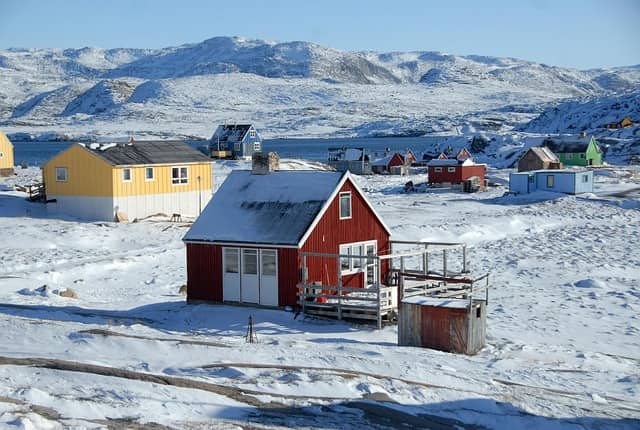
Despite a smaller footprint, the base continues to play a critical role in Greenland geopolitics:
- Early-warning missile detection
- Arctic surveillance and space monitoring
- Tracking Russian military activity
- Supporting NATO’s northern defense
As Arctic tensions rise, Greenland’s military importance is central to U.S. and NATO strategy.
Arctic Militarization and Rising Global Competition
The increasing militarization of the Arctic has intensified Greenland’s geopolitical significance. Russia has expanded its Arctic bases, deployed advanced missile systems, and increased submarine patrols. China, declaring itself a “near-Arctic state,” invests in research, infrastructure, and long-term Arctic access strategies.
These developments have heightened global concern. Losing influence over Greenland could weaken NATO’s northern flank and reduce early-warning capabilities at a critical time. In this context, Greenland geopolitics is directly linked to deterrence, defense doctrine, and Arctic stability.
Rare Earth Minerals and Greenland Geopolitics
Beyond military strategy, Greenland holds immense economic potential. The island is believed to contain substantial reserves of:
- Rare earth elements
- Critical minerals
- Oil and natural gas
Rare earth minerals are essential for modern technologies like electric vehicles, wind turbines, satellites, and advanced weapons. With China dominating global supply chains, access to Greenland’s resources strengthens Western leverage and is a key dimension of Greenland geopolitics.
Arctic Shipping Routes and Strategic Significance
Climate change is reshaping Greenland’s strategic importance. Melting polar ice is opening previously inaccessible Arctic sea routes, altering global trade dynamics.
Two emerging routes are particularly relevant:
- The Northwest Passage
- The Transpolar Sea Route
Greenland’s position at the crossroads of these routes gives it substantial commercial and strategic significance. Control over or influence in Greenland allows monitoring and management of critical shipping lanes, reinforcing the role of Greenland geopolitics in global trade and security.
Political Debate: Sovereignty vs. Strategic Necessity
Despite rising interest from foreign powers, Greenlanders consistently oppose external control. Public opinion favors eventual independence from Denmark and opposes annexation by any nation.
Denmark, which handles Greenland’s foreign affairs and defense, has warned that any attempt at forced control could undermine NATO cohesion and international law. This tension highlights a central challenge in Greenland geopolitics: balancing strategic necessity with respect for sovereignty.
Missile Defense and Greenland Geopolitics
Missile defense is another driving force in Greenland geopolitics. Hypersonic and advanced missile threats require forward-deployed systems closer to potential launch sites.
Greenland offers unmatched advantages for radar coverage, interceptor deployment, and space monitoring. As missile defense strategies evolve, Greenland’s role in Greenland geopolitics is becoming increasingly pivotal.
Why Greenland Geopolitics Is a Global Turning Point
Competition over Greenland signals a larger shift in global power dynamics. The Arctic is no longer a remote frontier—it is a center of military, economic, and technological rivalry.
Greenland geopolitics now encompasses:
- National security and missile defense
- Rare earth and mineral resource competition
- Climate-driven shipping routes
- NATO cohesion and Arctic militarization
Decisions regarding Greenland in the coming years may shape international stability for decades.
Frequently Asked Questions (FAQ)
Why is Greenland strategically important?
Greenland’s geographic location, role in missile defense, Arctic surveillance, and naval chokepoints make it critical in Greenland geopolitics.
Why are world powers competing for Greenland now?
Rising Arctic militarization, resource competition, emerging shipping routes, and missile threats have increased Greenland’s strategic relevance.
Does the U.S. have a base in Greenland?
Yes. Pituffik Space Base in northwest Greenland supports missile warning systems, Arctic surveillance, and NATO operations, highlighting U.S. involvement in Greenland geopolitics.
What is China’s role in Greenland geopolitics?
China seeks access to Arctic resources and trade routes, investing in infrastructure and research to secure long-term influence.
Do Greenlanders support foreign control?
No. Most oppose annexation and favor eventual independence from Denmark, reflecting the tension between sovereignty and strategic necessity in Greenland geopolitics.
Conclusion: Greenland as the New Arctic Power Center
Greenland has transformed from a frozen, remote island into a key geopolitical prize. Climate change, military strategy, technological advancement, and resource competition converge to make Greenland geopolitics central to global power dynamics.
For further analysis on Arctic strategy, military developments, and global power competition, visit Documentary Times—your trusted source for in-depth, fact-driven reporting.